Eminescu - Longest Love Poem
Mihai Eminescu is considered Europe's last great romantic not in the least because he gave voice of such unmistakable music to the sadness of love.
The "Luceafarul" (Evening Star) by Mihai Eminescu, a 98 stanzas long poem about the impossible love between immortal Evening Star and a beautiful mortal princess sets the world record for the Longest Love Poem.
The Legend of the Evening Star ("Luceafarul") is a story about a young princess who prayed to the evening star each night. The evening star falls in love with her and is willing to give up his immortality, but realizes that the pure love he has for the young girl cannot be sustained in the mortal world.
(read the poem)
The 100+ yrs old linden tree from the "Copou Park" of Iasi where the poet Mihai Eminescu use to get his inspiration, also known as "The Lovers Tree" has become a favorite destination for true romantic lovers from around the world. Tourists from all the world-as far as Japan or Brazil- are coming here and kissing nearby the tree-which is supposed to bring good luck in love.
*** NASA named after "Eminescu" an impact crater from Mercury (14 ianuarie 2008)
*** Mihai Eminescu was also declared "UNESCO-Year-2000-Poet-Of-The-Year".
Labels: eminescu
is Constanta worth discovering?
Ryanair announces a new flight: from Pisa to Constanta
To celebrate the inauguration of the new routes, Ryanair will offer flights for 19.99 euro.
(Ryanair announces new flights from Pisa
...
From Pisa with Ryanair you can connect to destinations right across the European mainland, the UK, Ireland and also the islands of Malta and Sardinia for example. And so suddenly, this tiny untouched corner of Romania is about to be discovered.
But is Constanta worth discovering?
Well, yes, we think it is. And as it is in Romania where Liam Bailey recently told the International Herald Tribune that there is still room for property price growth, he probably thinks it is too!
There is a huge amount of room for growth there - Romania's Black Sea coast is fairly undiscovered and actually ripe for investment. The climate is as beautiful in the summer and as temperate in the winter, and Constanta is a major port and resort on the coast making it a perfect base for exploring all the fantastic beaches, landmarks, museums and natural attractions in the vicinity.
As for current property prices, well they're not dirt cheap because Constanta is already very popular with Romanians as a holiday hotspot, but prices are not exactly expensive either. You'll pay from EUR 48,000 for a one-bedroom apartment for example, and you can buy beach-side villas with five bedrooms, four bathrooms and extensive gardens for about EUR 393,000 currently.
Land is for sale in abundance in the vicinity of the city - which may be of interest to developers who like the thought that the city is to get its own cheap flight access from April... or for those who want to start earning straight away, there are hotels for sale which could of course accommodate European and British holidaymakers from this summer onwards.
If you're looking for property in Romania for an investment, a second home abroad or a home from home in the sun and you're willing to take a risk, be in it at least for the medium term and buy into a still emerging market, give Constanta a closer look - it'll be even easier to do so from April after all!
(Room for Property Price Growth in Romania)
Class One Romanian Grand Prix
Mamaia, August 31 – September 2
The first race in the world Offshore Formula 1 circuit organized in Romania takes place during August 31 – September 2 on Siutghiol lake at Mamaia, near Constanta. Organizers expect to have over 100,000 spectators and this Formula 1 race to bring Constanta on the world sport map.
Class One represents the equivalent of Offshore Formula 1 and is the most spectacular race of high class powerboats. The boats are around 15 meters long, have two engines of 900 hp each, and can reach a speed of 360 km/h. (by Nine oClock)
2007 CALENDAR
- finalised venues
8-10 June GREECE - Athens
20-22 July NORWAY - Arendal
31 August - 2 September ROMANIA - Constanta
28-30 September RESERVE DATE
8-10 November QATAR - Doha
15-17 November QATAR - Doha
29 November- 2 December U.A.E. - Dubai
6-8 December U.A.E. - Dubai
- venues to be finalised:
29 June-1 July SLOVENIA - Portorose-Piran
10-12 August NORWAY - Oslo
(28-30 September RESERVE DATE France, Villefranche or Italy, Syracuse or Spain, Gijon)
The Danube Delta
Biosphere Reservation
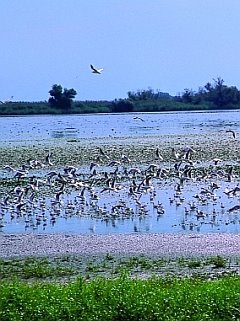
This astonishing realm of waters is home for three hundred bird species and numerous fish species - over 45 -, from sturgeons to carps and perches, while the 1150 plant species range from lianas creeping on tree trunks in oak forests to water lilies.
It is no wonder that UNESCO designated the Danube Delta as a "Biosphere Reservation". The Danube Delta Biosphere Reservation holds a triple international protection status: Biosphere Reservation, internationally nominated by the UNESCO Committee "Man and the Biosphere", International Wet Area nominated by the Ramsar Convention Secretariat, and World Natural Heritage Site recognised by UNESCO. More...
Landscape of the Year - Bridges within Europe
The Danube Delta was officially proclaimed the Landscape of The Year 2007-2008 by the Presidents’ Conference of International Friends of Nature.
The valuable areas of the delta need to be protected, as they are part of the assets that the Central and Eastern European Countries have to contribute to the European Union. It is our duty to use them frugally and to preserve them for future generations. More
Bram Stoker's DraculaOne of the most romantic stories ever told
The background of this story is the myth / legend of Count Vlad Dracula (son of count Dracul) ‘nicknamed' Vlad Tepes (Vlad the impaler). Vlad was, as the film tells us a warlord in the 15th century who fought the Turks. According to the myth he drank the blood of his victims and impaled them.
A lot of information about Vlad Dracula was later gathered by Irish writer Bram Stoker, who, combined it with myths of vampires into this tale of the well known blood - sucking Vampire.
Stoker read the stories about Dracula printed in the 15th and 16th centuries and was struck by his acts of cruelty. He decided to make him his character; he also read several books about Transylvania (a name of Latin origin, meaning "the country beyond the forests"), and thought that this "exotic" land would make a proper setting for Dracula's deeds.
In fact, Stoker used Vlad only as a source of inspiration, since in his novel, Dracula is not prince Vlad the Impaler, but a Transylvanian count living in a mysterious castle where he lured his victims.
His story takes place in the Bistritza area, and the castle lies near the Bârgau Pass (in the Carpathian Mountains).
As Stoker had never visited Transylvania, most places and happenings were pure fiction.
Legend and true history about Dracula intermingle and are being kept alive by tourist destinations like:- Bran Castle near Brasov
- Dracula's Castle Hotel in the Borgo Pass (Birgau Mountains)
- The Golden Crown in Bistrita, where you can eat the meal Jonathan Harker ate
- House of Dracula's childhood in Sighisoara that is now a nice restaurant
- Ruins of Dracula's palace (Old Court) in Bucharest
- Ruins of the Poienari fortress (rebuilt by Vlad Dracul) near Curtea de Arges
- Ruins of the Royal Place and Chindia Tower in Tirgoviste, the capital during Vlad Dracul's reign.
If you have another trip to the Bahamas planned for next Christmas and are a fan of Stoker's literary work, maybe should you reconsider your decision?
Just have a look...
LINKS- http://www.eskimo.com/~mwirkk/castle/vlad/vladhist.html
- http://www.ici.ro/romania/en/turism/drachist.html
- http://members.aol.com/johnfranc/drac05.htm
- http://www.ucs.mun.ca/~emiller/
- http://www.donlinke.com/drakula/vlad.htm

Romanian customs symbols
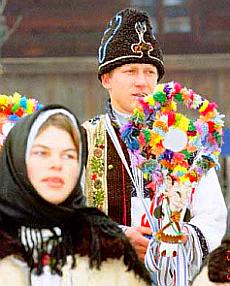
Once endowed with a ritual function, customs still are a specific way of communicating in the village world. Moreover, they help consolidate the relations within the community. Certain customs, spectacular in character, have made their way into the city. The major customs are related to calendar events or the rites of passage. The former belong to the whole community, combining Christian significances with elements of old agrarian rituals. Though revolving around Christmas, the winter holidays, for instance, also include customs recalling the celebration of winter solstice. This is a moment of magic brightness, when people rejoice at the fruit of the year drawing to an end and express confidence in the New Year.
Merry Christmas!More:
Cultural Confluences

Constantin Brâncusi- Wisdom of Earth
Lying at the crossroads that link the Orient and the Occident, Romania claims to belong to both.
If modern Romanian literature is the offspring of Romanian culture grafted onto Western cultural trends, the old Romanian legends and beliefs lie under the sign of another spiritual zodiac, that of myth and ancient sages.
Mircea Eliade emphasized that what is characteristic to Romanian culture and differentiates it from the European one is, in fact, its affiliation to the ancient background of universal values.
The Indian values which reached Romania directly or indirectly have represented for the Romanians a world in which they have re-discovered their own cultural vitality.
- Dacian-Getic invasion by the Roman conquerors is somewhat similar to that of India's invasion by the Aryans.
- "Miorita", the most widespread Romanian myth, has been found to practice a doctrine resembling ahimsa - non-violence.
- The entire work of Brancusi, inspired from the endless source of ancient Romanian folklore, represents the reiteration of India's cultural ethos through the centuries.
More:
România and the UNESCO mondial heritage
Sarmizegetusa
DACIAN FORTRESSES OF THE ORASTIE MOUNTAINS
... six Late Iron-Age defensive works, created in the 1st centuries BC and AD as protection against Roman conquest.
DANUBE DELTA
... largest and best preserved of European deltas. The Danube Delta hosts over 300 species of birds as well as 45 freshwater fish species in its numerous lakes and marches.
CHURCHES OF BUCOVINA
With their painted exterior walls, decorated with 15th and 16th century frescoes, masterpieces of Byzantine art, these seven churches (Arbore, Humor, Moldovita, Patrauti, Probota, Sfantu Gheorghe of Suceava and Voronet) are unique in Europe.
MONASTERY OF HOREZU
... a masterpiece of "Brancovan" style, known for its architectural purity and balance, the richness of its sculpted detail, its treatment of religious compositions, its votive portraits and its painted decorative works.
SAXON VILLAGES WITH FORTIFIED CHURCHES IN TRANSYLVANIA
... The seven villages inscribed are characterized by the specific land-use system, settlement pattern, and organization of the family farmstead units preserved since the late Middle Ages, dominated by their fortified churches, which illustrate building periods from the 13th to 16th centuries.
WOODEN CHURCHES OF MARAMURES
... provide a vivid picture of the variety of design and craftsmanship expressed by narrow but high timber constructions with their characteristic tall, slim clock towers at the western end of the building, single or double roofed and covered by shingles.
HISTORIC CENTER OF SIGHISOARA
... best-preserved 15th century citadel and the only medieval inhabited citadel in Europe. ...
Read more
The Begining
"Thinker" and "Siting Woman" from Hamangia
...Inside the Romanian territory have been discovered the traces of various civilizations between 7,500 - 3,500 B.C.
...The "Pre-Cucuteni" culture is considered by the American specialist Marija Gimbutos for being the oldest European culture with the pre-Indo-European population at its development apogee between 5,000 - 4,000 B.C.
...The "Boian" culture (4,000 - 3,800 B.C.) left us the first sanctuary created from clay and the "Hamangia" culture the first statue worked in marble in human history and the anthropomorphous clay statues "The Thinker and his woman."
...From "Vincea" culture, in 1961 Nicolae Vlasa discovered at Tartaria upon Mures (Transylvania) some small clay tablets dated 4,800 - 4,500 B.C., considered by the same Gimbutas as the very first written message in human history, much before the Sumerians tablets (probably arising also from the Danube).
...Those Carpatho-Danubers (also called "ARIANS") gave birth to the world's culture, spreading not only all over Europe and toward North Egypt and Mesopotamia, but to the far India, where their "Vedic" culture "inspired" (and is still inspiring today) the world's cultures - the Chaldeans, the Egyptians, and others. The Hinduism and Christianity did not do anything else but copy, adjusting it to their local conditions ...
Read more
Vlad Tepes (the Impaler). History and legend.
Foto: Simona Doxan - http://simona.deltanet.ro
Vlad Tepes was also known as Dracula, a name that became due to an abundant literature the prototype of a bloody tyrant. In fact, this was his father’s name, Vlad Dracul (with the origin in the Dragons Order, a chivalrous Order of that time). As a consequence, he became the Devil’s son, Draculea, Dracula. The Saxons from Transylvania, who were menaced to lose their privileges by the protectionist policy of the Wallachia voivode, spread the tales on Tepes cruelties. We can consider, anyway, that Vlad Tepes was a man of his times, since the cruelty was one of the methods used by the rulers to rich their goals ... Read more
Vlad Tepes related sites